

When considering conversation optimization for estate planning law firms, you must look beyond web traffic. Driving traffic to your estate planning law firm’s website is often treated as the primary objective of marketing, yet in practice it is only the beginning of the client acquisition process, and in many cases, not even the most important part.
Because traffic alone does not generate revenue.
What matters is what happens next.
If prospective clients arrive on your website after searching for terms such as “estate planning attorney near me” or “Medicaid planning lawyer,” and then leave without scheduling a consultation, requesting guidance, or taking a defined next step, the issue is not visibility, it is conversion.
And for most estate planning firms, this is precisely where the breakdown occurs.
The Estate Planning Sales Funnel: Where Firms Lose Momentum
To understand conversion properly, it is necessary to step back and view your marketing through the lens of a structured funnel, rather than isolated tactics.
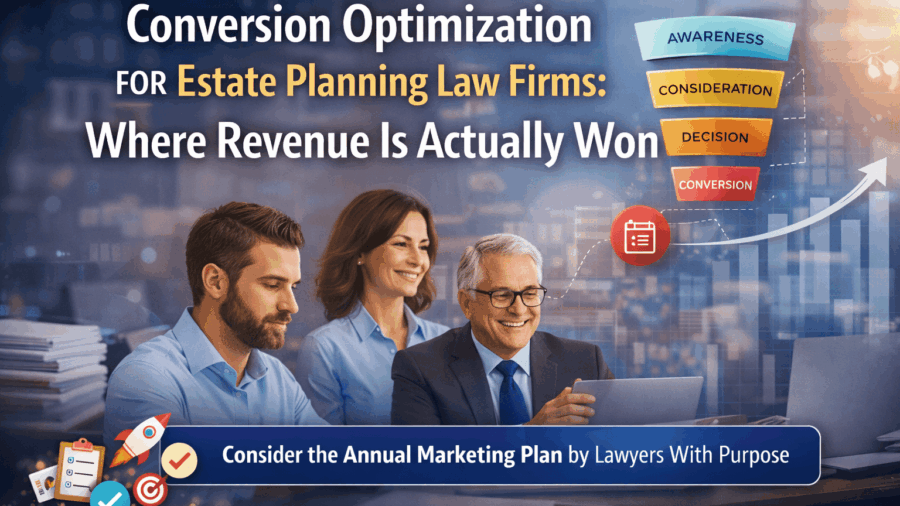
At a high level, every prospective client moves through four stages:
- Awareness — discovering your firm through search, referrals, or content
- Consideration — evaluating whether you are the right fit
- Decision — determining whether to engage with you
- Conversion — taking action by booking a consultation or becoming a client
Most estate planning attorneys invest heavily in the awareness stage, focusing on SEO, referrals, and content creation, but far fewer firms give the same level of attention to the transition between consideration and decision.
This is where conversion optimization sits.
And this is where the majority of revenue is either captured—or lost.
Why Estate Planning Conversion Is Uniquely Complex
Unlike transactional services, estate planning requires a client to make a series of layered decisions, often involving long-term financial implications, family considerations, and a degree of emotional resistance tied to topics such as incapacity or mortality.
This means that when a prospective client lands on your website, they are not simply asking, “What services do you offer?”
They are asking:
- “Can I trust this firm with something this important?”
- “Do they understand my situation?”
- “What happens if I move forward?”
- “Is this the right time to act?”
If your website does not answer these questions clearly and confidently, the client does not move forward—not because they are not interested, but because they are not yet certain.
Your Website Is the Bridge Between Interest and Action
In this context, your website is not a digital brochure.
It is the most critical stage of your intake system.
It must guide a prospective client from passive interest to active decision-making, doing the work that would otherwise happen in a first consultation.
Firms that approach their websites this way begin to see a shift.
Instead of presenting information, they begin structuring an experience.
Instead of listing services, they begin guiding decisions.
The Role of Content in Conversion Rate Optimisation for Estate Planning Firms
Content plays a far more significant role in conversion than many attorneys realise, particularly in a field where trust, clarity, and understanding directly influence whether a client takes action.
When a prospective client arrives on your website, they are not simply scanning—they are evaluating.
They are looking for content that reflects their concerns, answers their questions, and demonstrates that your firm has both the expertise and the structure to guide them effectively.
This is where content becomes a conversion tool, not just an educational one.
High-performing estate planning firms use content to:
- Clarify complex decisions in plain, client-focused language
- Address common concerns before they are raised in consultation
- Reinforce authority through consistent, relevant publishing
- Create alignment between what the client reads and what they will experience
This often includes the strategic use of:
- Dedicated landing pages tailored to specific services such as Medicaid planning, asset protection, or trust administration, ensuring that each visitor is met with highly relevant messaging rather than generic information
- Well-structured FAQs, which address the exact questions clients are already thinking about, reducing uncertainty and increasing confidence
- Regularly updated content, including blogs, guides, and practical insights, which signal both authority and relevance in an evolving legal landscape
When done correctly, content does not simply inform.
It removes hesitation.
Where Conversion Breaks Down in Estate Planning Websites
In most firms, conversion issues are not caused by a single failure, but by a series of small inefficiencies that accumulate.
A website may present valuable information, but fail to provide a clear next step.
A call-to-action may exist, but lack specificity, leaving the client uncertain about what they are committing to.
Trust signals may be present, but not positioned where they are needed most—at the point of decision.
And the intake process may function operationally, but not strategically, resulting in delayed responses or inconsistent follow-up.
Each of these moments introduces friction.
And in a decision process that already carries weight, friction is often enough to stop momentum entirely.
Conversion Optimization as Friction Reduction
At its core, conversion optimization is not about persuasion.
It is about reducing resistance.
That means making it easier for a prospective client to:
- Understand what you do
- Trust how you do it
- And take the next step without hesitation
This requires intentional design across multiple areas.
A website structure that presents clear pathways to book a consultation ensures that users are never left wondering what to do next.
Calls-to-action that are specific and outcome-driven—such as “Book Your Estate Planning Session”—create clarity around what action involves, rather than relying on vague prompts like “Contact Us.”
Trust signals, including reviews, testimonials, credentials, and clearly explained processes, must be visible at the exact moment a client is deciding whether to move forward.
And the intake process must be structured, responsive, and consistent, recognising that conversion does not happen in a single interaction, but often across multiple touchpoints.
The Overlooked Power of Intake and Follow-Up
One of the most significant gaps in estate planning conversion is what happens after a prospective client expresses interest.
Research consistently shows that multiple interactions are often required before a decision is made, which means that follow-up is not simply a courtesy—it is a critical component of conversion.
Firms that rely on inconsistent or delayed responses inevitably lose opportunities to competitors who respond more quickly and with greater clarity.
By contrast, firms that systemize intake and follow-up—ensuring timely communication, clear next steps, and consistent messaging—are able to convert a significantly higher percentage of the same volume of leads.
This is not a marketing advantage.
It is an operational one.
A Practical Conversion Checklist for Estate Planning Attorneys
For firms looking to assess whether their website is truly conversion-ready, the following considerations provide a useful starting point:
- Does your website load quickly and function seamlessly across mobile devices, recognising that a growing proportion of clients will first encounter your firm on a phone rather than a desktop?
- Are your calls-to-action clear, specific, and consistently positioned throughout your site, guiding users toward a defined next step rather than leaving them to navigate independently?
- Are your forms simple and efficient, requesting only the information necessary to initiate a conversation, rather than overwhelming the user at the point of decision?
- Is your content written with your client in mind, addressing real concerns, scenarios, and decision points, rather than focusing solely on legal explanations?
- Are you actively using analytics to understand where users drop off, how they behave, and what pathways lead to conversion?
- Have you implemented structured testing—whether through A/B testing or iterative improvements—to refine your messaging, layout, and user experience over time?
Each of these elements contributes to a broader system.
And it is the system, rather than any individual tactic, that ultimately determines performance.
From Traffic to Clients: A Shift in Perspective
What becomes clear when viewing conversion through this lens is that most estate planning firms are not lacking opportunity.
They are under-leveraging it.
The traffic they are generating, the referrals they are receiving, and the interest they are attracting already represent significant potential.
The question is whether that potential is being guided effectively through the funnel.
When your website functions as a structured pre-consultation experience, when your content aligns with how clients think and decide, and when your intake process supports rather than interrupts that journey, conversion improves—not incrementally, but meaningfully.
Conversion Optimization in Estate Planning Marketing
Conversion optimization is often framed as a technical discipline, focused on incremental adjustments to pages, forms, and design elements.
In reality, it is a reflection of how well your firm understands the client journey.
It requires a shift from thinking about marketing as a way to generate attention, to thinking about it as a way to guide decisions.
Because in estate planning, the firms that grow are not those that attract the most traffic.
They are the ones that make it easiest for the right clients to say yes.
The Annual Marketing Plan (AMP) by Lawyers With Purpose was designed to solve exactly this problem.
Rather than approaching marketing as a collection of isolated tactics, AMP provides a structured, strategic framework that aligns:
- Your content with how clients actually make decisions
- Your website with a clear conversion pathway
- Your messaging with your consultation and enrollment process
- Your marketing efforts with measurable growth targets
It removes the need to constantly ask, “What should we be doing next?”
And replaces it with a plan that is already built, tested, and aligned with how estate planning firms grow.
For attorneys who are ready to move beyond sporadic marketing efforts and begin building a practice where demand, conversion, and revenue are all working together, AMP is the next step to consider.
Because at this stage, growth is no longer about doing more.
It is about doing the right things, in the right order, with the right structure behind them.
About the Author
Saima Omar is a content marketing strategist and SEO copywriter who helps professional service firms turn content into a consistent source of growth.
A trained journalist with a Master’s in Journalism, Saima brings over a decade of experience working across content, SEO, and brand strategy, partnering with more than 100 businesses globally, from fintech and SaaS to legal and professional services.
Her work sits at the intersection of strategy and execution. Rather than producing content for visibility alone, she focuses on building systems that educate, position, and convert, helping firms move prospects through the sales funnel with clarity and intent.
Saima has worked closely with estate planning and legal organizations, including Lawyers With Purpose, where she supports content, messaging, and marketing strategy designed to help attorneys grow more structured, scalable practices.